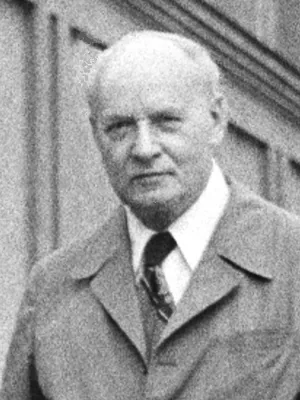

Marian Mazur is regarded as the founder of the Polish school of cybernetics [Pawlak 2020]; the Polish Wikipedia calls him its co-founder and most important representative [Wikipedia PL]. In education, upbringing, psychology and — to a lesser extent — in the theory of organisation and management he had opponents from the start [Pawlak 2020]. In 1988 Grzegorz Królikiewicz made a documentary about him, Prekursor (‘The Precursor’) [autonom.edu.pl, ‘Prekursor’; Wikipedia PL]. The school was at its most popular in the 1970s, and Cybernetyka i charakter (‘Cybernetics and Character’) was forgotten over time [Pawlak 2020].
Childhood and studies
He was born in Radom on 7 December 1909 [Wikipedia PL], into a poor family [Wojciechowski 1984]. His father was a tinsmith in the railway workshops [Wojciechowski 1984; Wikipedia PL]. According to his mother's recollections he was an exceptionally gifted child: he learnt to read early and came to enjoy solving mathematical problems [Wojciechowski 1984]. He passed his school-leaving examination (matura) as the best pupil in 1927, at the Gimnazjum im. Jana Kochanowskiego (Jan Kochanowski Grammar School) in Radom [Wikipedia PL]. He graduated from the Wydział Elektryczny Politechniki Warszawskiej (Faculty of Electrical Engineering, Warsaw University of Technology) [Lechowski 1987; Mikke 1982].
Engineer at the State Telecommunications Institute
From 1935 he worked at the Warsaw-based Państwowy Instytut Telekomunikacyjny (State Telecommunications Institute) [Lechowski 1987]. He was put in charge of an electrical measurements laboratory that did not yet exist — he had to create it first [Mikke 1982]. He built it and, alongside the classical test stands, added one based on his own measuring method, published in Kwartalnik Telekomunikacyjny (‘Telecommunications Quarterly’) [Lechowski 1987]. From 1937 he worked on the full automation of long-distance telephone connections on the Warsaw–Katowice line and brought it to the stage of a working laboratory model [Lechowski 1987; Mikke 1982]; further implementation was cut short by the war [Mikke 1982]. This work produced a fully automatic date stamp that took account of the irregularities of the calendar and of leap years by itself [Lechowski 1987].
The war: the first version of the theory
During the occupation he was in hiding in Warsaw and in a country manor house near the city [Wikipedia PL]. His mother died in Auschwitz [Wojciechowski 1984]. Cut off from science as practised in institutions, he had, on the other hand, complete freedom in choosing his subject [Mikke 1982; Lechowski 1987]. He then took up the application of the concepts of automatic control to mental processes and looked for a common conceptual apparatus for organisms and machines [Mikke 1982; Lechowski 1987]. In 1942–1944 [Wikipedia PL; Lechowski 1987], in a manuscript of about 200 pages, he set down the groundwork of the theory of układy samodzielne — systems which not only control themselves but also counteract the loss of this ability [Lechowski 1987]. The manuscript was destroyed in the Warsaw Uprising [Lechowski 1987; Wikipedia PL]. All this happened before 1948, the year in which Norbert Wiener's book, regarded as the beginning of cybernetics, was published [Mikke 1982].
Electroheat and terminology
After the war he worked briefly at the Ministerstwo Przemysłu i Handlu (Ministry of Industry and Trade, 1946–1947) [Lechowski 1987]. In 1948 he moved to the Instytut Elektrotechniki (Electrotechnical Institute), where he expanded the measurement laboratories and took up electroheat [Lechowski 1987; Mikke 1982]. In 1951 he obtained his doctorate for a thesis on the back radiation of heating coils; the formula he introduced in it found its way into textbooks [Lechowski 1987]. In 1954 he became an associate professor (profesor nadzwyczajny) and remained one until the end of his life [Lechowski 1987]. He studied radiant (infrared) heating: he developed a method of calculating the temperature distribution in thin coatings (e.g. lacquer coatings), which could not be measured because of their negligible thickness, and built an instrument for measuring the efficiency of radiant heaters [Lechowski 1987].
At the same time he worked on technical terminology: in the Stowarzyszenie Elektryków Polskich (Association of Polish Electrical Engineers) he served on the Centralna Komisja Słownictwa Elektrycznego (Central Commission for Electrical Terminology), first as secretary (1948–1955), then as chairman (1955–1963), and in his book Terminologia techniczna (‘Technical Terminology’, 1961) he formulated 14 principles for creating terms [Lechowski 1987]. He was also active in international organisations: from 1960 he chaired Study Committee 27 (Electroheat) of the Międzynarodowa Komisja Elektrotechniczna (International Electrotechnical Commission) [Lechowski 1987; Wikipedia EN]. In 1964–1967 he chaired a coordinating team in which the Warsaw University of Technology, the Electrotechnical Institute and the Huta Stalowa Wola (Stalowa Wola Steelworks) worked together; the team developed the automation of steelmaking electric arc furnaces [Lechowski 1987].
Cybernetics
For a long time the authorities were unfavourably disposed towards cybernetics [Lechowski 1987]; until the second half of the 1950s it was arcane knowledge in Poland [Mikke 1982], identified with pseudoscience [Wojciechowski 1984]. In 1956 Mazur returned to the theory of układy samodzielne and concluded that the work of Wiener and Shannon had not deprived his conception of its novelty [Lechowski 1987]. In 1966 he published Cybernetyczna teoria układów samodzielnych (‘A Cybernetic Theory of Autonomous Systems’, PWN) [Lechowski 1987]. In 1967 he moved to the Zakład Prakseologii Polskiej Akademii Nauk (Department of Praxiology, Polish Academy of Sciences), where he worked on cybernetics and the science of science [Lechowski 1987; Mikke 1982]. For the Komitet Naukoznawstwa PAN (Committee for the Science of Science, Polish Academy of Sciences) he developed a numerical method for drawing up a priority list of research topics [Lechowski 1987].
In 1970 Jakościowa teoria informacji (‘A Qualitative Theory of Information’, WNT) was published [Lechowski 1987]. In it Mazur explained what the understanding, meaning and content of information consist in, and showed that Shannon's theory concerns only identifying information, not describing information [Lechowski 1987; Mikke 1982]. The book also appeared in Russian (1974) and in French (1976) [Mikke 1982]. In the same year he published Historia naturalna polskiego naukowca (‘A Natural History of the Polish Scientist’) — a collection of texts on the organisation of science [Lechowski 1987], which received an award from the weekly Kultura in 1971 [Lechowski 1987].
From 1974 to 1979, until his retirement, he worked at an institute concerned with science policy, technological progress and higher education (IPNPTiSW) [Mikke 1982; Wikipedia PL]. He spent the academic year 1974/75 in Paris as a lecturer in cybernetics at the EHESS, the School for Advanced Studies in the Social Sciences [Mikke 1982; Wikipedia PL], and in 1977 he was a consultant to Rice University in Houston in the field of artificial intelligence [Mikke 1982; Wikipedia EN]. In 1976 he published Cybernetyka i charakter (‘Cybernetics and Character’, PIW) [Lechowski 1987; Mikke 1982].
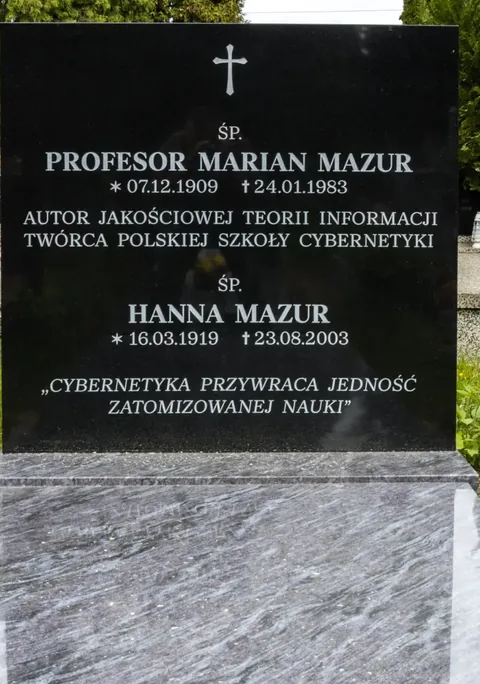
The sources give the number of his works differently: about 200 [Mikke 1982], 170 [Wojciechowski 1984], 146 up to 1976 [Lechowski 1987]. He supervised doctoral theses and made great demands on his doctoral students, while being an exceptionally cheerful and kind person [Lechowski 1987]. Outside science he was occupied with literature and art; he made music himself, composed and also wrote for the theatre [Wojciechowski 1984]. He died in Warsaw on 21 January 1983 [Wojciechowski 1984]; the burial register of the Cmentarz Komunalny Północny (Northern Communal Cemetery) and the plaque on his grave give the date as 24 January 1983 [Warsaw municipal cemeteries]. The discrepancy came to light in 2024, when the grave was renovated through the efforts of the author of the project: the date on the new plaque was copied from the cemetery register [Account of the project's author]. He is buried in the Northern Communal Cemetery [Wikipedia PL; Wikipedia EN].
His legacy
In his scientific work he kept to a few principles. Observations could test a theory, but they did not enter into its proof [Lechowski 1987]; he developed his account of human character through theoretical deduction, not from observing human types [Mikke 1982]. For him, building definitions meant building a theory [Wojciechowski 1984], and his reasoning and conceptual apparatus were marked by rigorous precision [Lechowski 1987]. The correctness of a statement was to be settled by proof, not by authority [Mikke 1982; Wojciechowski 1984].
He complemented cybernetics, whose models were unsuited to describing living organisms, with a language for describing systems that control themselves in their own interest, and showed that human beings, too, belong to the autonomous systems [Wojciechowski 1984; Mikke 1982]; the theory also covers communities [Lechowski 1987]. He described thought processes in physical terms: energy, potential, conductance [Lechowski 1987; Mikke 1982], and he defined character as a set of rigid control properties of a human being, distinguishing it from personality, which also includes the flexible properties (właściwości elastyczne) [Mikke 1982; Wikipedia EN].
The sources differ in a few details (among others, the year of graduation: 1934 or 1935); we omit such details, and where we do give them, we state which source says what.
Sources
- [Lechowski 1987] ‘Życiorys naukowy profesora Mariana Mazura (1909–1983)’ (‘The scientific biography of Professor Marian Mazur (1909–1983)’), author: J. Lechowski; Postępy Cybernetyki 1987, vol. 10, no. 2, pp. 7–20 (digital copy on autonom.edu.pl, without page divisions; we give the page range of the article).
- [Mikke 1982] J. Mikke, Wizerunki ludzi myślących (‘Portraits of Thinking People’), Warsaw 1982 (2nd enlarged edition, Wydawnictwa Radia i Telewizji), chapter ‘Człowiek i maszyna’ (‘Man and Machine’), pp. 187–215 (digital copy without page divisions).
- [Wojciechowski 1984] A. Wojciechowski, ‘Śladami wybitnych uczonych. Prekursor’ (‘In the footsteps of eminent scholars. The Precursor’), Przegląd Tygodniowy 1984, no. 9 (100) of 26 February, p. 14 (copy: autonom.edu.pl, accessed 13.10.2026).
- [Pawlak 2020] A. Pawlak, ‘Zapomniany geniusz. Prof. Marian Mazur i jego szkoła cybernetyki’ (‘The forgotten Genius. Prof. Marian Mazur and the Polish School of Cybernetics’), e-mentor, no. 5 (87), 2020, pp. 5–14.
- [Wikipedia PL] ‘Marian Mazur (naukowiec)’, pl.wikipedia.org, accessed 13.10.2026 (the article is marked in Wikipedia as requiring verification).
- [Wikipedia EN] ‘Marian Mazur’, en.wikipedia.org, accessed 13.10.2026.
- [autonom.edu.pl, ‘Prekursor’] page of the film Prekursor (‘The Precursor’), dir. G. Królikiewicz, 1988, autonom.edu.pl, accessed 13.10.2026.
- [Warsaw municipal cemeteries] search engine for people buried in the municipal cemeteries of the City of Warsaw, entry ‘Marian Mazur, 07-12-1909 – 24-01-1983, Północny W-VII-11, rząd 4, grób 3’ (Northern Cemetery, section W-VII-11, row 4, grave 3), accessed 14.10.2026.
- [Account of the project's author] the project author's account of the renovation of Marian Mazur's grave in 2024, given on 14.10.2026.
Other texts about Mazur listed in the digitisation catalogue, not used in this version: J. Mikke, Wizerunki ludzi myślących (‘Portraits of Thinking People’), 1st edition (1973), chapter ‘Człowiek i maszyna’ (‘Man and Machine’); M. Kempisty (ed.), Mały słownik cybernetyczny (‘A Short Dictionary of Cybernetics’, 1973); J. Lechowski, ‘Metody i konsekwencje poznawcze twórczości Mariana Mazura’ (‘Methods and cognitive consequences of Marian Mazur's work’), Nauka Polska (1987); P. Müldner-Nieckowski, ‘Słowo wstępne’ (‘Foreword’) and ‘Aneks’ (‘Appendix’) in the 1996 edition of Cybernetyka i charakter; ‘Status teoretyczno-metodologiczny teorii systemów autonomicznych’ (‘The theoretical and methodological status of the theory of autonomous systems’) by Z. Zaniewski (1996); J. Lechowski, ‘Przedmowa’ (‘Preface’) to the 1999 edition; E. Nowakowska, ‘Społeczne funkcjonowanie norm etycznych w ujęciu twórców Polskiej Szkoły Cybernetycznej’ (‘The social functioning of ethical norms as seen by the founders of the Polish Cybernetic School’, 2000) and ‘Geneza polskiej szkoły cybernetyki społecznej’ (‘The origins of the Polish school of social cybernetics’, 2002); I. Rajewska, ‘Cybernetyka a charakter’ (‘Cybernetics and character’, 1980); P. Sienkiewicz, ‘Charaktery, czyli o cybernetyce Mariana Mazura’ (‘Characters, or on the cybernetics of Marian Mazur’), chapter VII in: Poszukiwanie golema. O cybernetyce i cybernetykach (‘In Search of the Golem: On Cybernetics and Cyberneticians’, 1988).
Mazur and Western cybernetics — Mazur's concepts alongside those of Wiener, Shannon and Ashby